Nano Concept, Environment, Yoga and Anuvrat: A Path Towards Holistic Living
Introduction
Education is not limited to books, examinations, degrees, or professional knowledge. True education helps a person understand oneself, other people, society, and the natural environment. It develops knowledge, health, discipline, values, responsibility, compassion, and the ability to make thoughtful decisions.
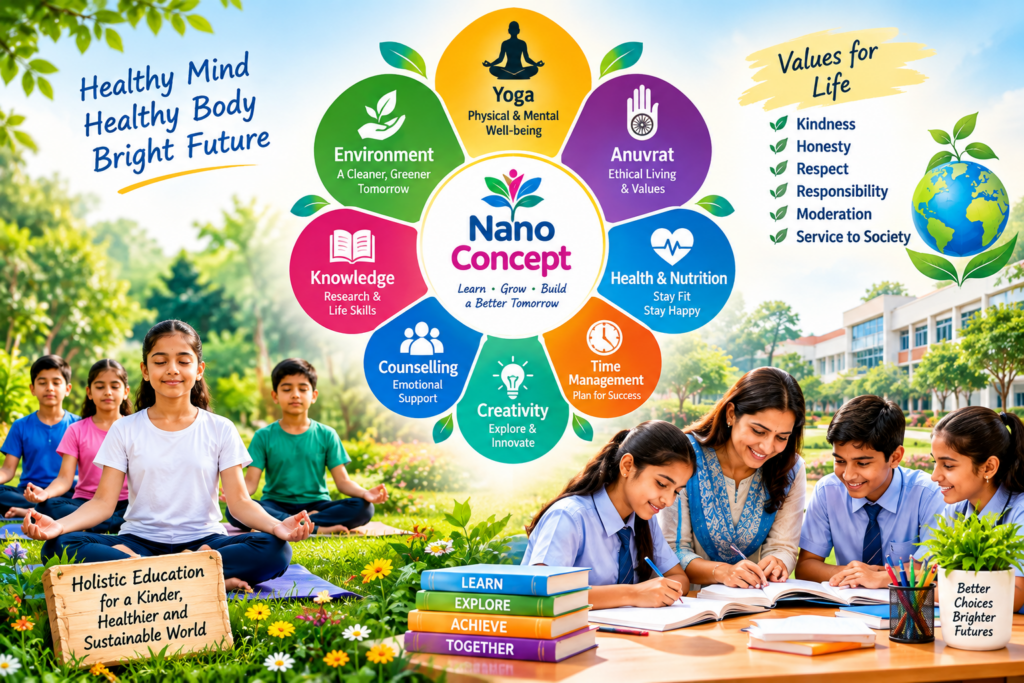
At Nano Concept, we believe that education should contribute to the all-round development of an individual. Research education, counselling, health and nutrition, environmental awareness, modern teaching strategies, problem-solving, creativity, and moral values can work together to create a balanced and responsible human being.
In this context, Yoga and the principles of Anuvrat in Jainism provide meaningful ideas for developing self-discipline, peaceful living, responsible behaviour, and respect for life and nature.
Yoga encourages balance between body, mind, and inner awareness. Anuvrat encourages individuals to practise small but meaningful vows in everyday life. Environmental responsibility encourages us to use natural resources thoughtfully and protect the world around us.
Together, these ideas can support a healthier, more peaceful, and environmentally responsible way of living.
Nano Concept and the Idea of Holistic Education
Holistic education looks at the learner as a complete person. Academic learning is important, but it is only one part of development.
A learner also needs:
- Physical health and fitness
- Mental concentration and emotional balance
- Good communication and social relationships
- Ethical and responsible behaviour
- Environmental awareness
- Creativity and curiosity
- Research and problem-solving skills
- Respect for people, animals, and nature
Nano Concept seeks to bring these dimensions together through learner-friendly educational approaches.
The purpose is not simply to provide information but to encourage learners to understand, reflect, practise, and apply knowledge in daily life.
This approach is particularly relevant today when students and families face challenges related to stress, excessive consumption, environmental changes, distractions, and unhealthy lifestyles.
Yoga: Developing Balance Within
Yoga is traditionally associated with practices that support physical health, breathing, concentration, meditation, and inner balance. For learners, Yoga can become a useful part of a healthy daily routine when practised appropriately.
Simple Yoga practices can encourage:
- Better body awareness
- Flexibility and physical activity
- Calmness and relaxation
- Concentration and attention
- Mindful breathing
- Self-discipline
- Awareness of the connection between body and mind
For students, a calm and attentive mind can support learning. A short period of mindful breathing, stretching, or suitable Yoga practice can provide a positive transition between activities.
Yoga also teaches an important lesson: balance matters. Just as the body needs balanced care, our lifestyle needs balance between study and recreation, work and rest, technology and real-life interaction, consumption and conservation.
Anuvrat: Small Vows for Responsible Living
The word Anuvrat is associated with the idea of practising small vows or ethical commitments in everyday life. The Anuvrat movement, inspired by Jain ethical thought, emphasises practical self-discipline and responsible conduct.
The approach can be understood as encouraging people to bring ethical awareness into ordinary actions rather than treating values as ideas limited to books.
Important Jain principles commonly associated with this ethical tradition include:
Ahimsa – Non-violence
Ahimsa encourages respect for life and avoidance of unnecessary harm. In an environmental context, this can inspire greater sensitivity towards animals, plants, natural resources, and other living beings.
Satya – Truthfulness
Truthfulness develops trust and responsible communication. In education, it encourages learners to be honest in their work, research, communication, and relationships.
Asteya – Non-stealing
Asteya teaches respect for what belongs to others. Its broader application can encourage responsible use of shared resources and discourage wasteful or unfair practices.
Brahmacharya – Responsible Conduct
This principle is traditionally understood in different ways within Jain ethical thought. In everyday life, it can be connected with self-control, responsible behaviour, and disciplined use of one’s energy and attention.
Aparigraha – Limiting Possessions
Aparigraha encourages moderation and reducing unnecessary attachment to possessions. This idea has a strong connection with environmental responsibility because excessive consumption can place pressure on natural resources.
These principles can be introduced to learners not as complicated philosophical concepts, but as opportunities to ask simple questions:
Do I really need this? Am I wasting something? Can I avoid harming another living being? Am I being truthful? Am I treating nature responsibly?
Such questions can turn values into everyday practice.
Environment: Our Shared Responsibility
The environment provides the air we breathe, the water we drink, the food we eat, and the natural resources needed for life. Environmental education therefore needs to be an important part of modern learning.
Environmental responsibility can begin with small habits:
- Avoiding unnecessary wastage of water
- Saving electricity
- Reducing unnecessary plastic use
- Reusing useful materials
- Keeping surroundings clean
- Planting and caring for trees
- Respecting animals and other living beings
- Choosing mindful consumption
- Avoiding unnecessary food waste
These actions may appear small, but education becomes meaningful when knowledge is translated into responsible behaviour.
The connection between Yoga, Anuvrat, and environmental awareness becomes especially interesting here. Yoga develops awareness of the body and mind. Anuvrat encourages ethical self-discipline. Environmental education extends responsibility towards our surroundings.
Thus, the journey can move from:
Self-awareness → Self-discipline → Responsible action → Environmental care
What Yoga and Anuvrat Can Teach Students
Children and young people learn not only from textbooks but also from observation, practice, and the behaviour of adults around them.
Yoga can introduce habits of attention, discipline, breathing, movement, and relaxation.
Anuvrat can introduce questions of ethics, responsibility, moderation, truthfulness, and non-violence.
Environmental education can encourage care for nature and responsible use of resources.
Together, these approaches can help learners develop qualities such as:
Discipline | Compassion | Awareness | Responsibility | Moderation | Respect | Concentration | Self-control
The goal should not be to force every learner into one particular practice. Instead, educators and families can create opportunities for children to understand values and gradually apply them according to their age and circumstances.
Role of Parents and Teachers
Parents and teachers have an important role in creating an environment where healthy habits and ethical values can grow naturally.
Instead of only telling children to save water, adults can demonstrate water conservation. Instead of simply discussing kindness, they can show kindness. Instead of talking about environmental protection, families can practise responsible consumption.
Teachers can connect classroom learning with real-life activities.
For example, a science lesson can discuss water conservation. A language lesson can involve writing about nature. A social studies activity can explore responsible citizenship. A Yoga session can introduce mindful breathing and suitable physical practices. A values-based discussion can explore truthfulness, non-violence, moderation, and respect.
This interdisciplinary approach makes education more meaningful.
Nano Concept: Connecting Knowledge with Life
The vision of Nano Concept is closely connected with the idea that education should support all-round development.
Research helps us ask questions and understand evidence.
Education helps us develop knowledge and skills.
Yoga can support awareness, physical activity, concentration, and balance.
Anuvrat provides an ethical framework for reflecting on everyday choices.
Environmental education reminds us that our actions affect the world around us.
Counselling and guidance can help learners and families deal thoughtfully with challenges.
When these areas are connected, education becomes more than academic preparation. It becomes preparation for responsible living.
Simple Practices for Everyday Life
A family, school, or educational institution can begin with simple activities:
- Begin the day with a few minutes of quiet breathing or suitable Yoga practice.
- Keep a small “Save Nature” activity for each week.
- Encourage children to avoid unnecessary waste.
- Discuss one value—such as truthfulness or compassion—each week.
- Maintain plants or a small school garden.
- Encourage mindful use of digital devices and time.
- Celebrate acts of kindness and responsible behaviour.
- Discuss the difference between “need” and “want.”
- Encourage students to observe environmental problems and suggest solutions.
- Connect research projects with real environmental and social issues.
The objective is not perfection. The objective is continuous improvement through small, meaningful actions.
Conclusion
Nano Concept, Environment, Yoga, and Anuvrat can be viewed as complementary pathways towards holistic development.
Nano Concept brings together education, research, health, counselling, environmental awareness, creativity, and values.
Yoga encourages awareness and balance of body and mind.
Anuvrat encourages ethical self-discipline through practical commitments in everyday life.
Environmental education encourages us to understand our dependence on nature and act responsibly.
The common message is simple: meaningful change begins with awareness and everyday action.
A peaceful mind, a healthy body, responsible choices, compassion towards living beings, and respect for nature can contribute to a more balanced way of living.
Education therefore has a larger purpose than acquiring knowledge. It can help us become thoughtful learners, responsible citizens, caring human beings, and respectful members of the natural world.
At Nano Concept, this connection between knowledge, health, values, research, environment, and all-round development can form an important foundation for meaningful and joyful learning.